
Reviewed · AMMAN TOURS
Private Tour: Full-Day Islamic Desert Castles and Ajloun Castle Trip from Amman
Jordan’s desert castles are not grand palaces in the European sense. They are scattered Umayyad hunting lodges, way stations, bathhouses, and forts, spread across the eastern plains. This private day links them with Ajloun Castle, where you finish among hilltop walls, stairways, and views over northern Jordan.
I like two things here: you get a private car and flexible pace, and the route reaches places that many first-time visitors skip. Guides such as Mazen, Hasan, and Amer have been praised for punctual service, cultural insight, and patient explanations. The drawback is simple: ten hours is a long day, with plenty of time in the car and several sites that are atmospheric rather than grand.
Key points to know before booking
- Quseir Amra has the day’s most unusual art: faded Umayyad frescoes include a domed zodiac and scenes of music, bathing, wine, and court life.
- Azraq is built from black basalt: its heavy stone walls and Lawrence of Arabia connection give it a different feel from the other desert sites.
- Ajloun changes the scenery completely: after the open eastern plains, you reach a medieval fortress above greener hills and the Jordan Valley.
- Your driver is also your guide: Mazen, Hasan, and Amer are named in the supplied experience details as guides who have handled this route.
- This is a private tour, not a fixed group outing: only your party rides together, and you can ask to spend more time at a site.
- Bring sun protection and walking shoes: shade is limited, and the forts involve uneven ground, stairs, and exposed courtyards.
Why this private desert-castle route is worth your day
The main appeal is variety. In one outing, you see early Islamic architecture, a small bathhouse covered with precious wall paintings, a square desert fortress, a black-stone stronghold, and a later castle built under Saladin.
I like that the trip gets you beyond Amman’s familiar sights without asking you to arrange several separate transfers. Hotel pickup and drop-off remove much of the fuss, and the air-conditioned vehicle matters in eastern Jordan, where the road can feel very exposed under the sun.
The private format also gives the day a more human pace. You are not tied to a large group waiting for everyone to finish photographs. If you want more time in a courtyard or need a short break, you can tell your driver. That flexibility is especially useful at Quseir Amra, where a short visit can easily become rushed.
The tradeoff is distance. The eastern castles sit far from Amman, while Ajloun lies in the opposite direction, northwest of the desert route. The stated duration is about ten hours, and the stop descriptions allocate roughly ninety minutes to each desert castle, followed by a long return section after Ajloun. You should book this as a full historical day, not a relaxed outing with long meals and leisurely wandering.
More Jerash and Ajloun trips:
- Full-Day Tour: Umm Qais, Jerash, and Ajloun from Amman
★ 5.0 · 162 reviews - Private Tour of Ajlun and Jerash
★ 5.0 · 130 reviews - Jerash, Ajloun, Umm Qais Day Trip
★ 5.0 · 99 reviews
The road from Amman into eastern Jordan
Pickup is scheduled for 9:00 a.m. from central Amman. You leave the city in a private vehicle with an English-speaking driver, heading across the dry plains toward the desert castles.
This transfer is part of the experience. The castles are not packed into one compact museum complex. They sit apart from modern Amman, and the open countryside helps explain why Umayyad rulers used this area for hunting, retreats, administration, and travel.
Your driver can share information about Jordanian culture, daily life, and recent events as you go. The private setting makes it easy to ask questions without holding up a busload of people. Hasan is specifically noted for explaining the sites, offering water and fruit, and giving useful advice for later sightseeing. Mazen was praised for patience and for discussing Jordanian culture and current life. Amer is also described as both a professional driver and a guide.
Do not expect a full formal lecture from the driver at every stop. The included service is an English-speaking driver, while an additional guide at the desert castles depends on the option selected. If detailed archaeological explanation is important to you, check that guide option before paying.
Quseir Amra and its remarkable painted bathhouse
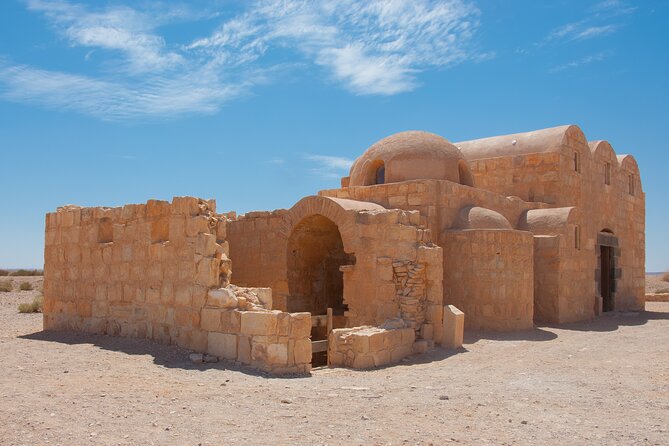
Quseir Amra is the artistic prize of the route. It is UNESCO-listed and much smaller than the word castle may suggest. The building was an Umayyad hunting palace and bathing retreat, and its importance lies inside as much as outside.
The faded frescoes are the reason to come. The walls show courtly scenes, musicians, bathing figures, animals, and other images that feel surprisingly worldly for an early Islamic building. The domed bath chamber includes a painted zodiac, an unusual survival that makes this modest structure far more memorable than its size suggests.
I would spend your time slowly here. Look up at the dome, study the surviving wall scenes, and notice how the building’s vaulted rooms were arranged. The paintings are delicate, so do not expect bright, freshly colored decoration. Their age and fading are part of the experience, but visitors who want towering walls or intact furniture may find the site underwhelming at first.
The planned stop is about ninety minutes, including time to walk around and listen to explanations. That is generous for a small monument, yet useful if you want to examine the paintings rather than take a quick photograph and leave.
Qasr Al-Kharaneh, a square fortress on the plain
Qasr Al-Kharaneh has the strongest classic fortress shape of the eastern stops. Its square, two-level form, rounded corner turrets, and central courtyard make it easy to picture as a defensive building, even though its exact purpose remains uncertain.
Archaeologists have linked it to several possible roles. It may have served as a fortress, a meeting place, or a caravanserai for officials and other travelers. It may also have older Roman foundations. That uncertainty is useful rather than frustrating, because the building sits at the meeting point of several architectural traditions, including Mesopotamian, Arabic, and Greek influences.
Inside, rooms line the courtyard. Look for ornamental pilasters, niches, and the simple geometry of the design. The building has a stern, almost stage-set appearance against the wide plain, and it photographs well from outside.
Here, I would set your expectations correctly. Kharaneh is not filled with displays or furnished rooms. Its value comes from the structure itself, the proportions, and the question of how it was used. The supplied schedule allows around ninety minutes, which gives you time to walk through the rooms and hear the explanation without rushing.
A few more Amman trips to weigh up
- From Amman: Petra and Wadi rum Full day Tour
★ 5.0 · 538 reviews - Petra Full-Day Private Tour from Amman
★ 4.9 · 392 reviews - Amman Petra Full-Day Trip
★ 5.0 · 270 reviews - From Amman : Full day tour to Petra
★ 5.0 · 250 reviews
Qasr Al-Azraq and the Lawrence connection
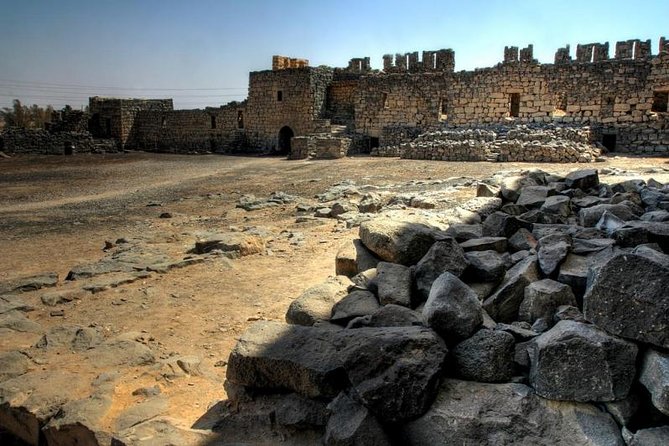
Qasr Al-Azraq was built from dark basalt in the middle of the Al-Azraq oasis. The black stone gives it a heavier, more severe appearance than Quseir Amra or Kharaneh, whose pale walls blend into the desert.
The fortress began as an Umayyad hunting retreat and later became a base for T.E. Lawrence during the Arab Revolt. Lawrence, better known as Lawrence of Arabia, used the site during operations in 1917 and 1918. That connection adds modern military history to an otherwise much older monument.
Walk through the courtyard and look at the arches, towers, mosque, and thick walls. The remains are atmospheric rather than polished. You get a sense of a working stronghold, not a restored royal residence.
The site can feel sun-baked and austere. That is exactly why I like placing it alongside the other castles: the materials and mood are different. If your main interest is Lawrence, keep in mind that the fortress itself is the attraction, not a large exhibition devoted to him. Your driver or local guide can provide context, but the supplied details do not promise a dedicated Lawrence museum or extended talk.
The stop is listed at about ninety minutes. Wear shoes with a firm sole, carry water, and bring a hat. On this part of the route, comfort matters more than fashion.
Ajloun Castle brings a medieval change of mood
After the eastern desert castles, the route heads to Ajloun Castle, also called Qala’at ar-Rabad. This is a 12th-century hilltop fortress built during the time of Saladin to help resist Crusader armies.
Ajloun feels different from the Umayyad sites in both age and setting. It is a larger medieval defensive complex, with corridors, staircases, towers, and thick walls that remain partly intact. The fortress rewards active exploration. You move through its interior rather than simply viewing a small building from a marked path.
Look for the murder holes, openings through which defenders could drop hot oil or pitch on attackers. Details like this make the castle easier to understand. The walls were not just impressive shapes. They were working defenses designed to control movement and protect the people inside.
The best views come from the towers. From up here, you look across the greener hills and toward the Jordan Valley. This change from open desert plains to northern hill country gives the day a strong final act.
The practical catch is timing. Ajloun is the last major stop, and the ride back to Amman is long. The itinerary gives four hours to the Ajloun portion, a figure that includes the visit and the return journey in the supplied schedule. You should not plan an important evening reservation immediately after the advertised end of the tour.
What the private vehicle and driver arrangement means
The tour includes hotel pickup and drop-off in an air-conditioned leisure vehicle suited to the number of people in your party. On-board Wi-Fi is also included.
For this route, private transport is a real part of the value. Public transport would not provide a practical way to link these separate monuments in one day, and hiring several taxis would create its own set of problems. You get a direct ride between sites, storage for your day bag, and the ability to speak privately with your driver.
The driver doubles as your guide, but the level of site interpretation can vary by the option you select and the individual assigned. The additional guide at the desert castles is included only with the guide option. English is the standard language; other languages can be requested.
The experience details name Mazen, Hasan, and Amer in connection with past departures. Hasan is described as a driver who also guided at Qasr Al-Harranah and Quseir Amra. Mazen is noted for being punctual, patient, and willing to discuss Jordanian life. Amer is described as polite and professional. These names give you useful examples of the service style, but you should not assume a particular person will be assigned unless the operator confirms it.
Food, water, and what to pack
Meals and drinks are not included unless you choose the lunch option. A vegetarian meal can be requested. One departure included an excellent lunch venue, but that should not be treated as part of the standard price unless you select lunch.
Most local tourist restaurants in Jordan do not serve alcohol. If that matters to you, the operator asks you to make your preference clear in advance so the restaurant choice can be discussed.
I would bring:
- A hat and sunscreen
- Comfortable walking shoes
- Water and small snacks
- A phone or camera with enough battery
- A light layer for the air-conditioned vehicle
You will walk over uneven surfaces, climb stairs, and spend time in exposed courtyards. Anyone with mobility concerns should contact the operator before booking. Most people can participate, but this is not a low-effort sightseeing day.
Price, entrance fees, and overall value
The listed price is $126.67 per person. Value depends on group size. For one person or a small party, it pays for private transport, hotel pickup and drop-off, an English-speaking driver, Wi-Fi, and entrance fees to Al-Azraq, Quseir Amra, Kharaneh, and Ajloun when you choose the option with fees included.
The private format is the main reason the price can make sense. You are paying to cover a wide route without arranging a rental car, fuel, navigation, parking, or separate admissions. Group discounts are offered, so the per-person value improves as your own party grows.
Jordan Pass holders should pay close attention to the booking option. If you purchase the tour with entrance fees and already hold a Jordan Pass, inform the operator so the included entrance charges can be reimbursed at the destination. Arab and Gulf Cooperation Council nationals are advised to choose the Jordan Pass option because reduced entrance fees apply, and direct payment at the sites may be cheaper.
The price does not include tips, personal expenses, beverages, or lunch unless selected. A tip for the driver is recommended, so include that in your day’s budget.
Who will get the most from this day
I would recommend this tour to someone who has already seen Petra and Amman and wants a different side of Jordan. It also suits history-minded visitors who prefer unusual small monuments to another busy city attraction.
It is a good choice for solo visitors who want private transport and a guide without joining a large group. The private setting can also feel reassuring for solo women, particularly when paired with a professional driver such as the service described for Mazen.
Families and small groups may like the freedom to adjust the pace, but children should be ready for a long car day and several sites with limited shade. Photographers will enjoy the stark contrast between black basalt, pale desert stone, painted interiors, and green northern hills.
I would skip it if your Jordan schedule is already packed with long transfers, or if you want a slow day with a full sit-down lunch and plenty of unplanned time. The route covers a lot of ground. Its reward is range, not relaxation.
Should you book the Islamic desert castles tour?
Book it if you want to see Quseir Amra’s rare frescoes, understand the desert castles as part of Jordan’s early Islamic past, and finish with a proper medieval fortress at Ajloun. The combination is stronger than any single desert castle alone.
Before booking, confirm three details: the pickup location, the entrance-fee option that matches your Jordan Pass status, and whether an additional guide at the desert castles is included. Ask about lunch if you want a meal arranged, and leave your evening free because the return to Amman can be late after a ten-hour day.
For the right pace, this is a rewarding cross-section of Jordan: small Umayyad monuments in the east, a Lawrence connection, and a powerful hilltop castle in the north.
FAQ
How long does the private desert castles and Ajloun Castle tour last?
The experience lasts approximately ten hours, including transportation from Amman, the site visits, and the return to your hotel.
What time does pickup begin?
The stated start time is 9:00 a.m. Pickup is offered from central Amman hotels.
Is transportation private?
Yes. Your group travels in a private, air-conditioned vehicle, and only your party participates in the activity.
Is hotel pickup and drop-off included?
Yes. Hotel pickup and drop-off are included. Airport pickup and drop-off can be arranged by request.
Which entrance fees are included?
Entrance fees for Al-Azraq, Quseir Amra, Qasr Al-Kharaneh, and Ajloun Castle are included when you select the option with entrance fees. Jordan Pass holders should contact the operator about reimbursement at the destination.
Is lunch included?
Lunch is not included in the standard arrangements. You can select an option with lunch, and a vegetarian meal can be requested.
What language is the tour provided in?
The tour is provided in English. Other languages can be requested.
Can people with mobility issues join?
Most people can participate, but the castles include uneven ground, corridors, towers, and stairs. Clients with mobility issues should contact the operator before booking.
Just added around Amman
- Private Tour: Jerash and Umm Qais Day Trip from Amman★ 4.0 · 3 reviews
- From Amman/Airport: 3-Night Private Jordan Special Tour★ 5.0 · 3 reviews
- From Amman | Dead sea and Petra in one day | Admission Fees Included★ 5.0 · 3 reviews
- Dead Sea & Jerash Full-Day Private Tour from Amman or Airport★ 5.0 · 3 reviews
- Private Guided Umm Quais and Jerash tour with lunch★ 5.0 · 3 reviews
- 4-Days tour : Jerash, Amman, Petra ,Wadi-rum& Dead-sea.★ 5.0 · 3 reviews
- Private Half-Day Ma’in Waterfalls and Hot Springs Tour from Amman★ 5.0 · 3 reviews
- Private Tour: Full Day Trip of Jerash, Umm Qais, and Pella from Amman★ 4.5 · 3 reviews
Amman Tours, compared.
2-Day Tour: Petra, Wadi Rum, and Dead Sea from Amman
Read our review →
2-Day Petra, Wadi Rum and Dead Sea Tour from Amman
Read our review →
3-Day Private Tour from Amman: Petra, Wadi Rum, Dana, Aqaba, and Dead Sea
Read our review →
Browse the lists this tour appears in