
Reviewed · AMMAN TOURS
Private Tour, Jerash and Amman City Tour
Jerash is the star here: a remarkably complete Roman city where you can walk beneath Hadrian’s Arch, across the Oval Forum, and along a long colonnaded street. Pairing it with Amman’s Citadel and Roman Theater gives you a useful first look at Jordan’s ancient and modern capital in one day.
I like the privacy and the flexible pace. Drivers such as Yusuf, Mohammad Bardaghawi, Saadah, and Abu Anas have been praised for arriving on time, explaining local culture, and offering helpful suggestions. I also like the comfortable minivan, hotel pickup, bottled water, and onboard WiFi.
The main thing to watch is the guide arrangement. This is generally driver-led rather than a fully guided archaeological tour, and site entry fees are not automatically included in every option. The optional Jerash guide is worth considering if you want detailed explanations rather than time to explore on your own.
Key points at a glance
- Walk through a nearly complete Roman city: Jerash includes Hadrian’s Arch, the Hippodrome, Oval Forum, Temple of Artemis, theaters, fountains, and colonnaded streets.
- See Amman from its highest historic perch: The Citadel combines Roman, Byzantine, and early Islamic remains with broad views over the city.
- Use a private minivan, not a shared bus: Hotel pickup and drop-off make this easy to fit into a short Amman stay.
- Choose your level of interpretation: Explore Jerash independently or add a local guide, depending on the booking option.
- Expect friendly driver service: Yusuf, Mohammad, Saadah, and Abu Anas are among the drivers praised for courtesy, flexibility, and local advice.
- Budget for admission fees: Entry to the major sites is listed separately, though the Jordan Pass may help eligible visitors reduce costs.
Why combine Jerash with Amman?
This is a smart pairing because the two places show very different sides of Jordan. Jerash is a broad archaeological site north of Amman, with long avenues, temples, theaters, and public spaces that make Roman urban planning easy to picture. Amman is a living city, where old ruins sit above crowded streets, shops, mosques, and modern neighborhoods.
The drive from Amman to Jerash covers about 31 miles, or 50 kilometers, and takes roughly an hour according to the timing described by the operator. You ride in a private, air-conditioned minivan, so you do not need to arrange a taxi, find an intercity bus, or negotiate transport at the end of the day.
I see the private format as the biggest practical advantage. You can ask the driver to pause, spend longer at a favorite site, or keep the day moving if the heat catches up with you. The tour usually lasts around seven hours, though the stated range is five to eight hours, so the exact rhythm can vary.
That flexibility matters in Amman. The Citadel and Roman Theater are close enough to combine, but the city’s hills and traffic can make a self-planned day less smooth than it looks on a map.
More Jerash and Ajloun trips:
- Full-Day Tour: Umm Qais, Jerash, and Ajloun from Amman
★ 5.0 · 162 reviews - Private Tour of Ajlun and Jerash
★ 5.0 · 130 reviews - Jerash, Ajloun, Umm Qais Day Trip
★ 5.0 · 99 reviews
Entering Jerash through Hadrian’s Arch
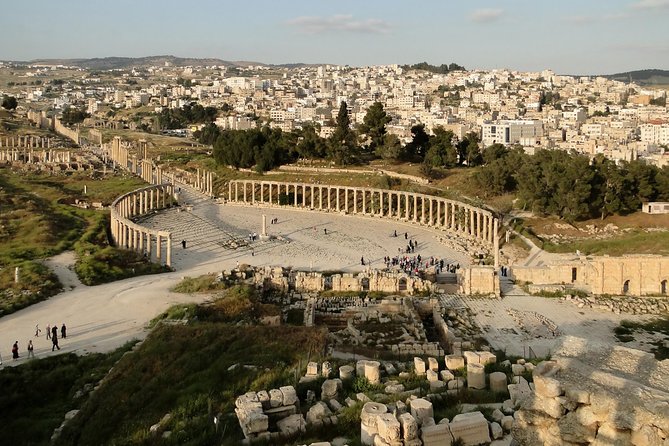
Allow about three hours for Jerash. The entrance sequence begins with Hadrian’s Arch, built around 130 AD to mark Emperor Hadrian’s visit. It is a fitting gateway, but do not stop there for only a quick photo. The scale of the site becomes clear as you continue beyond the arch toward the Hippodrome and the main city.
The Hippodrome was a sporting arena that could hold about 15,000 spectators. Its size helps you understand that Jerash was not a minor provincial outpost. Under Roman rule, it became one of the Decapolis cities, a group of major urban centers in the eastern part of the empire.
From there, the route leads into the Forum and its famous Oval Colonnade. The curved shape is one of Jerash’s most memorable features. Columns frame the open space, and the paving gives you a strong sense of how people once moved through this civic center.
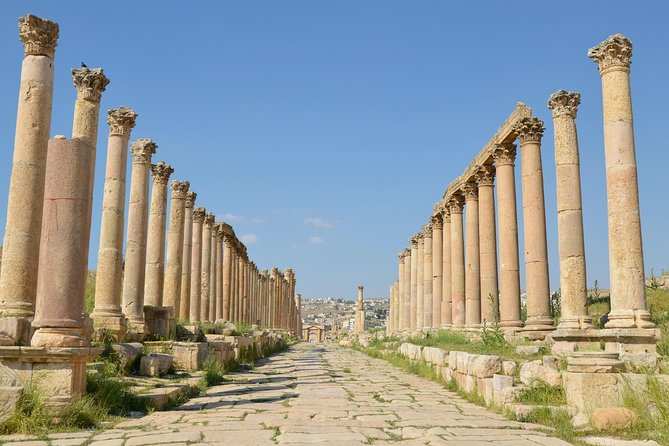
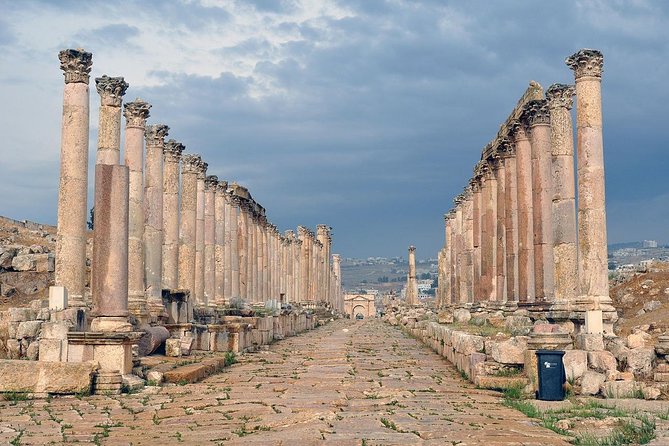
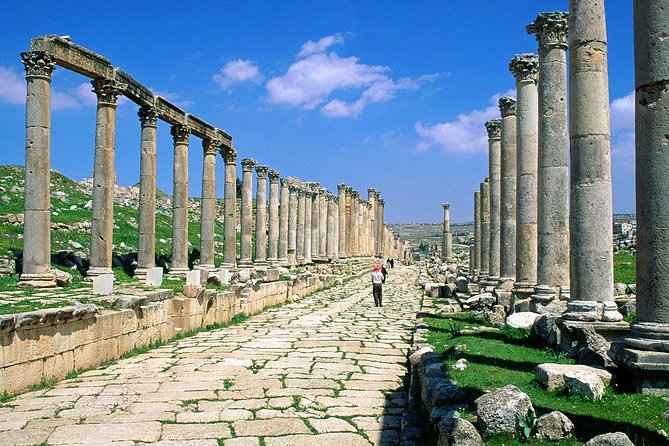
I recommend looking beyond the most obvious photo spots. The value of Jerash comes from the way the pieces connect: the forum leads toward the Colonnaded Street, public buildings sit beside temples, and the long views show how large the ancient city was.
The Temple of Artemis and Jerash’s theaters
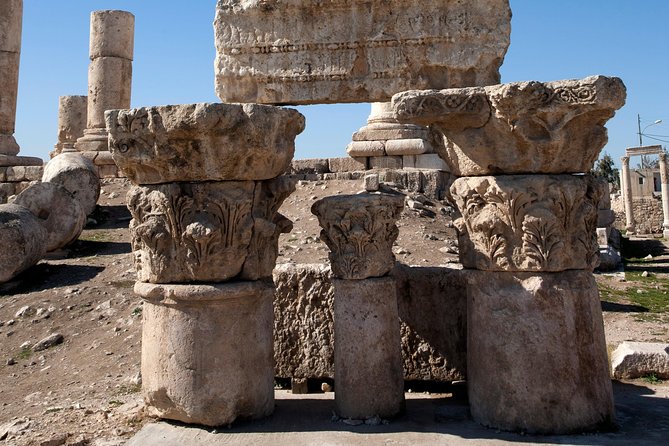
The Temple of Artemis is one of the site’s major landmarks. Its Corinthian columns rise about 39 feet, and the remaining structure gives you a clear idea of the temple’s former authority. Artemis was the city’s patron goddess, and the temple occupied an important place in Jerash’s religious life.
The South Theater is another highlight. Built in the second century AD, it could seat up to 5,000 people and is still used for performances. One review specifically notes a musical demonstration with bagpipes in a theater, a reminder that the site can feel more than silent stone when performances or demonstrations are taking place.
Jerash also includes the Nymphaeum, an ornamental fountain, and the long Colonnaded Street. These details help flesh out everyday life. Temples tell you about worship, but fountains, streets, theaters, and sporting arenas show how people gathered, watched events, walked, and conducted public business.
The site is large enough that three hours can pass quickly. If you explore without a guide, read the available signs and ask your driver for context where possible. If ancient architecture is your main reason for booking, add the local Jerash guide. The standard arrangement may leave you with a helpful driver but not a specialist explaining each monument in depth.
Private transport and the driver-led format
The vehicle is a private, air-conditioned minivan with hotel pickup and drop-off. Bottled water and WiFi onboard are included. Those features sound modest, but they are useful on a warm day after walking across exposed ruins.
The drivers receive the strongest praise in the supplied feedback. Yusuf is described as punctual and informative, with restaurant and sightseeing suggestions. Mohammad Bardaghawi is praised for making the day memorable, explaining culture, and taking extra care with the group. Saadah is noted for good English and a polite manner, while Abu Anas is praised for providing useful information throughout the day.
I would treat these names as examples, not a promise that one particular driver will be assigned to you. Still, they point to an important feature of the experience: the driver may offer more than a simple transfer. Several drivers have acted as informal local interpreters, answering questions and adjusting the schedule to suit the group.
That is valuable, but it is not the same as a licensed guide at every stop. One clear piece of practical advice is to confirm your selected option before booking. If the description says local guide optional, assume the basic price provides transportation and driver assistance, not a detailed guided tour inside every monument.
A few more Amman trips to weigh up
- Amman: Petra, Wadi Rum, and Dead Sea 2-Day Tour
★ 4.9 · 1,173 reviews - 2-Day Tour: Petra, Wadi Rum, and Dead Sea from Amman
★ 5.0 · 1,141 reviews - From Amman: Petra & Wadi Rum Private or group Day Tour
★ 4.9 · 750 reviews - From Amman: Petra and Wadi rum Full day Tour
★ 5.0 · 538 reviews
Amman Citadel: ruins above the city
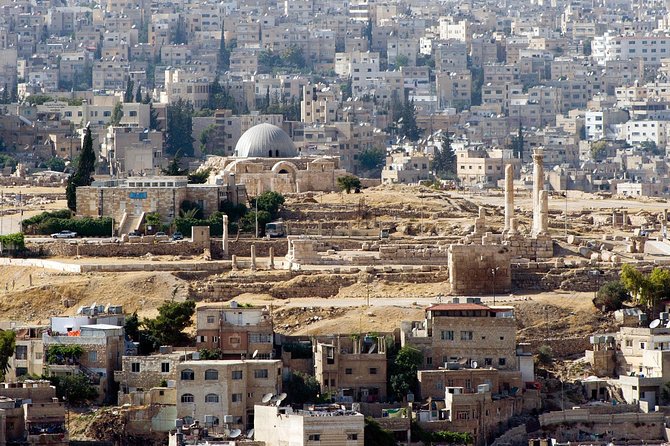
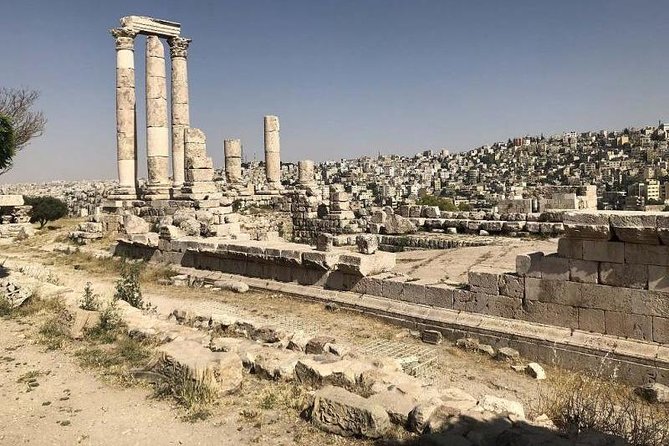
Back in Amman, the tour heads to the Citadel. This hilltop site brings together remains from several periods, including Roman, Byzantine, and early Islamic buildings. It also provides broad views across the capital, whose pale stone buildings spread over a series of hills.
The Roman Temple of Hercules dates from the second century. Even in its ruined form, the surviving elements give the hill a strong Roman presence. The Umayyad Palace, from the eighth century, shifts the focus to early Islamic Amman and adds a different architectural mood.
The Archaeological Museum is included in the Citadel visit as part of the planned stop. Its displays contain classical and Islamic finds from across Jordan. I like the museum as a counterpoint to the open-air ruins. At the Citadel, you see foundations, columns, and walls in their original setting. Inside, smaller objects can provide detail that the large monuments cannot.
Plan on about two hours at the Citadel area. The site is on a hill, and the visit includes walking over uneven ground and moving between ruins. You will get fine views, but this is not a flat, effortless museum visit. Comfortable shoes matter more here than fashionable ones.
The Roman Theater in downtown Amman
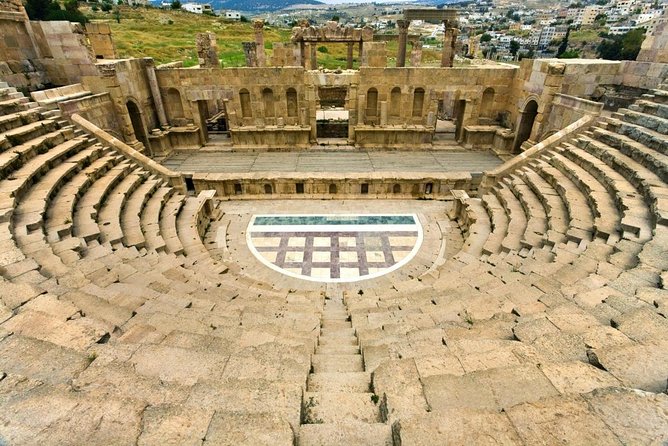
The Roman Theater is scheduled as a shorter stop, about 30 minutes. Cut into the hillside of Jabal Al-Jozfah, it was built around 161 AD during the reign of Antoninus Pius and could seat approximately 6,000 people.
The steeply raked seating is the main visual draw. Climb a few rows and look down toward the stage, then turn around for the city view. The theater’s scale is easier to appreciate from inside than from the street.
The stage facade includes Corinthian columns and carved details. The building later served different purposes, including use as a Christian church during the Byzantine period and a marketplace under Ottoman rule. That long reuse gives the monument a human connection. It was not simply built, abandoned, and forgotten.
The short scheduled visit is enough for a look and photographs, but it may feel rushed if you want to study the architecture. This is also the one point that deserves special attention when confirming the tour plan. One person reported that the Roman Theater was missed, while other descriptions place it firmly in the itinerary. Ask your driver at pickup to confirm the order and stops.
Souks, mosques, and optional additions
The final part of the day may include a closer look at Amman’s traditional souks. The itinerary also lists the King Abdullah I Mosque, known for its blue dome, and Souq Jara, a marketplace with spices, handicrafts, and local goods.
The exact inclusion of these stops appears to depend on timing and the day’s arrangement. One driver took a group to the Blue Mosque as an extra part of the tour, which shows how the private format can sometimes allow small adjustments. Do not assume every optional stop is guaranteed. Ask before you set expectations.
A short souk visit can be a good finish after a morning of ancient stones. You can see the working city, browse local products, and get a feel for Amman beyond its archaeological sites. If you want a full shopping session, though, seven hours may not leave enough time after Jerash, the Citadel, and the theater.
Is $83 per person good value?
At $83 per person, this tour is not the cheapest way to reach Jerash. A public bus or independently arranged taxi may cost less, especially for a solo visitor. But the comparison changes for a couple, family, or small group.
You are paying for private transportation, hotel pickup and return, air conditioning, bottled water, WiFi, and a full route linking Jerash with Amman’s main classical sights. You also avoid spending time arranging separate rides between the Citadel, downtown theater, and hotel.
Admission fees are not included in the base description. The price may vary by option, and one choice includes site admission while another may not. Check the exact booking selection before paying, then compare it with the Jordan Pass. One review specifically recommends the pass because it can cover entrance fees for eligible visitors.
The optional Jerash guide also affects value. If you already enjoy reading signs and exploring independently, the driver-only format may suit you. If you want a clear explanation of Roman streets, religious buildings, theater design, and the Decapolis, the added guide is the better spend.
Timing, comfort, and who should book
This works best as a first full day in Amman or as a compact introduction to northern Jordan. You get the major ancient sites without changing hotels, and the private vehicle keeps the day simple.
I would recommend it to:
- Couples who want a private schedule
- Families who prefer hotel pickup and flexible pacing
- First-time visitors with only one day for Amman and Jerash
- People who want a driver who can suggest restaurants and other places to visit
- Small groups for whom the per-person price becomes more attractive
I would be more cautious if you want a formal, lecture-style tour at every site. The standard trip is not described as fully guided throughout. I would also hesitate if you dislike a packed day. Jerash alone deserves time, and adding two Amman sites means several hours of walking and driving.
Most people can participate, but expect steps, slopes, uneven archaeological ground, and a climb around the Citadel and theater. The private vehicle gives you rest between stops, but it cannot remove the walking required once you arrive.
You can cancel for a full refund up to 24 hours before the start time. Changes made inside that 24-hour window are not accepted, so keep that deadline in mind when planning around flights or other Jordan excursions.
Should you book this Jerash and Amman tour?
I would book it if you want an efficient, private introduction to both places and value a friendly driver more than a formal guide. Jerash is the reason to go, and the Citadel adds excellent city views plus Roman, Byzantine, and Umayyad remains without requiring another day.
Before booking, check three things: the exact admission option, whether you are adding the local Jerash guide, and whether the Roman Theater and any mosque or souk stop are confirmed. If those details suit you, $83 per person is a fair price for private transport and a well-packed day.
FAQ
How long does the private Jerash and Amman tour last?
The tour lasts about seven hours, with the stated duration ranging from five to eight hours. The schedule includes roughly three hours at Jerash, two hours at the Citadel, and about 30 minutes at the Roman Theater, plus driving time.
Does the tour include hotel pickup and drop-off?
Yes. Pickup and drop-off at your Amman hotel are included.
Is transportation private?
Yes. You travel in a private, air-conditioned minivan, and only your group participates in the activity.
Is a local guide included at Jerash?
A local guide at Jerash is optional. You can select the tour option that includes a guide, or explore independently with the driver providing transport.
Are entrance fees included?
Entry fees are listed as not included, although the booking options may differ. Check the exact option you select, and consider the Jordan Pass if it applies to your visit.
What can you see at Jerash?
The visit includes Hadrian’s Arch, the Hippodrome, the Forum and Oval Colonnade, the Temple of Artemis, the South Theater, the Colonnaded Street, and the Nymphaeum.
What does the Amman portion include?
The planned Amman visits include the Citadel, the Archaeological Museum, and the Roman Theater. The itinerary also refers to traditional souks, the King Abdullah I Mosque, and Souq Jara, but confirm any extra stops with the operator.
Is WiFi available during the tour?
Yes. WiFi onboard and bottled water are included.
Can I cancel for a full refund?
Yes, if you cancel at least 24 hours before the experience start time. Cancellations or changes made less than 24 hours before the start time are not accepted for a refund.
Just added around Amman
- Private Tour: Jerash and Umm Qais Day Trip from Amman★ 4.0 · 3 reviews
- From Amman/Airport: 3-Night Private Jordan Special Tour★ 5.0 · 3 reviews
- From Amman | Dead sea and Petra in one day | Admission Fees Included★ 5.0 · 3 reviews
- Dead Sea & Jerash Full-Day Private Tour from Amman or Airport★ 5.0 · 3 reviews
- Private Guided Umm Quais and Jerash tour with lunch★ 5.0 · 3 reviews
- 4-Days tour : Jerash, Amman, Petra ,Wadi-rum& Dead-sea.★ 5.0 · 3 reviews
- Private Half-Day Ma’in Waterfalls and Hot Springs Tour from Amman★ 5.0 · 3 reviews
- Private Tour: Full Day Trip of Jerash, Umm Qais, and Pella from Amman★ 4.5 · 3 reviews
Amman Tours, compared.

2-Day Tour: Petra, Wadi Rum, and Dead Sea from Amman
Read our review →
2-Day Petra, Wadi Rum and Dead Sea Tour from Amman
Read our review →
3-Day Private Tour from Amman: Petra, Wadi Rum, Dana, Aqaba, and Dead Sea
Read our review →
Browse the lists this tour appears in