Reviewed · AMMAN TOURS
Full Day Jerusalem & Bethlehem Private Guided Tour From Amman
Crossing from Amman into Israel and the West Bank, then seeing Jerusalem and Bethlehem in one long day, is the main appeal here. You get major Christian, Jewish, and Muslim holy sites without arranging separate transport, parking, and border logistics yourself.
I like the private vehicle and the chance to shape the day around your own group. I also like the route itself: the Mount of Olives gives you the big Jerusalem view first, then the Old City brings you into the narrow lanes and sacred sites on foot. The drawback is clear: 11 to 12 hours is a demanding day, and border procedures, shuttle costs, entrance fees, visas, and departure taxes are not included.
Key points at a glance
- Mount of Olives views: Begin with sweeping views over Jerusalem and access to several important Christian sites.
- Old City walking route: Enter through Zion Gate and see the Western Wall, Via Dolorosa, and Church of the Holy Sepulchre.
- Three faiths in one day: The route includes places central to Jewish, Christian, and Muslim belief.
- Bethlehem finale: Spend about two hours in Bethlehem, including the Church of the Nativity and its underground grotto.
- Private transport from Amman: Ride in an air-conditioned vehicle with bottled water, parking, and private transportation included.
- Costs beyond the tour price: Plan separately for the border shuttle, visas, departure taxes, entrance fees, tips, and personal spending.
A very full day from Amman to Jerusalem
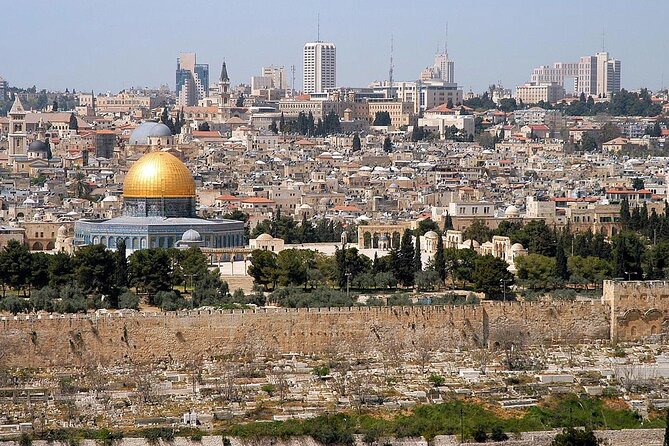
This is not a casual sightseeing outing. At about 11 to 12 hours, it is a cross-border mission with a powerful payoff: you can stand at the Western Wall in the morning, walk part of the Via Dolorosa, see the Church of the Holy Sepulchre, and finish in Bethlehem.
The private format matters here. You are not being moved around as part of a large group, and only your party takes part in the activity. That gives you more control over walking pace, photo stops, and the amount of time you spend listening at each place.
Transport is provided in an air-conditioned vehicle, with private transportation, parking fees, and bottled water included. An English-speaking driver accompanies you. If you choose the guided option, an escorted guide is available at the sites, which is the better choice if you want religious and historical context rather than simply a ride between landmarks.
The day still has practical friction. The shuttle bus used at the border between Jordan and Israel is extra, and so are visa and departure taxes. Entrance fees are also not included. Before booking, check that you have the required travel documents and budget for these additions.
A few more Amman trips to weigh up
- From Amman: Petra and Wadi rum Full day Tour
★ 5.0 · 538 reviews - Petra Full-Day Private Tour from Amman
★ 4.9 · 392 reviews - Amman Petra Full-Day Trip
★ 5.0 · 270 reviews
Mount of Olives: Jerusalem from above
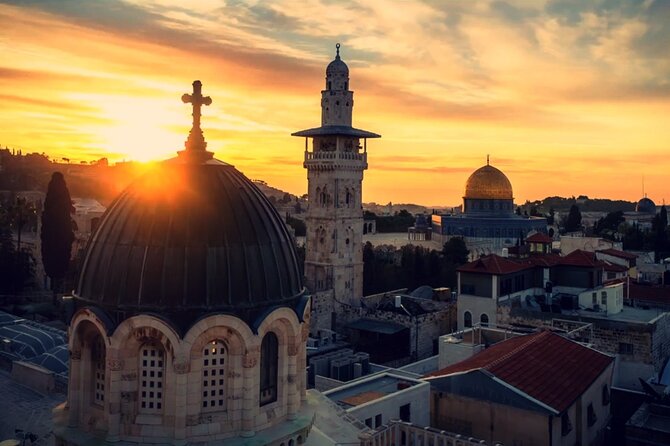
The Mount of Olives is a smart first stop because it helps you understand Jerusalem’s layout before you enter the Old City. From the high ground, you can look across toward the walled city and see why this hill has mattered to several faiths for centuries.
The mount is covered with churches and is home to what is described as the oldest continually used cemetery in the world. For Jewish belief, it is associated with the beginning of the resurrection on Judgement Day. For Christians, it is linked to Jesus’ ascension after the crucifixion and resurrection.
The Church of the Ascension sits near the top. The present church dates from 1910 and is noted for its views across Jerusalem. The Church of the Pater Noster is farther down the slope, beside the traditional place where Jesus taught his disciples.
You are scheduled for about an hour here, and admission is listed as free. Even so, do not expect a museum-style visit with a long, detailed interior tour at every church. The value is the combination of views, sacred traditions, and orientation to the city.
Temple Mount and the Dome of the Rock
The Temple Mount, also known as Haram Al-Sharif, is one of the most important and sensitive religious sites in Jerusalem. It matters to Jews and Muslims, and its history reaches back to the traditions of all three monotheistic faiths.
The site is associated with Abraham’s attempted sacrifice of his son, Solomon’s First Temple, and the Prophet Muhammad’s ascent to heaven. At the center of the wide plaza is the glittering Dome of the Rock, one of Jerusalem’s most recognizable buildings.
Admission is not included, and access arrangements can be subject to conditions that are not explained in the tour details. That makes it wise to treat this stop as an important possibility rather than assume every part of the sanctuary will be open for unrestricted entry.
Even from the plaza, the setting carries weight. You are looking at a place where religious belief and political claims are tightly linked. A good guide can explain the different traditions without turning the visit into a lecture or a debate.
Walking Jerusalem’s Old City
The Old City is where the tour changes character. After views from the Mount of Olives, you move into stone lanes, gates, shrines, and crowded passages that are best experienced on foot.
The fortifications date from the Ottoman period and include nine gates. Zion Gate is the main entry toward the Jewish Quarter, while Jaffa Gate is the principal route into the Christian Quarter. Damascus Gate and Lion’s Gate are also important points around the walls.
The tour description places your entry through Zion Gate. From there, your route connects several major sights, including the Western Wall, the Via Dolorosa, and the Church of the Holy Sepulchre.
The Old City can feel confusing at first. Streets turn sharply, religious quarters overlap, and the most significant doorway may look modest from outside. This is one part of the day where an escorted guide adds real value, especially if you want to understand how the city’s Jewish, Christian, and Muslim spaces sit side by side.
A walk along the ramparts is mentioned as another way to see the Old City, with routes running from Jaffa Gate toward Lion’s Gate or south toward Dung Gate. The schedule does not promise a rampart walk, so consider it an optional possibility rather than a guaranteed stop.
Same country, a completely different kind of day:
- Amman: Petra, Wadi Rum, and Dead Sea 2-Day Tour
★ 4.9 · 1,173 reviews - 2-Day Tour: Petra, Wadi Rum, and Dead Sea from Amman
★ 5.0 · 1,141 reviews - From Amman: Petra & Wadi Rum Private or group Day Tour
★ 4.9 · 750 reviews - 2-Day Petra, Wadi Rum and Dead Sea Tour from Amman
★ 5.0 · 467 reviews
The Western Wall and the sacred plaza
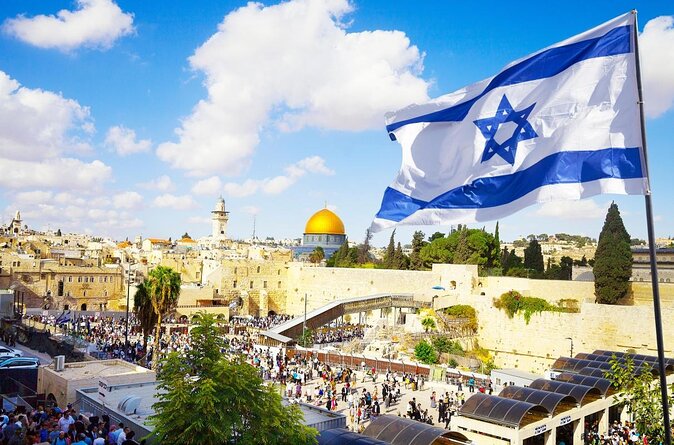
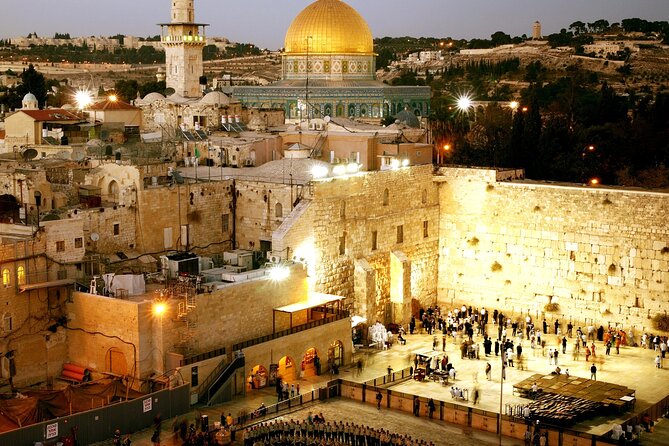
The Western Wall, often called the Wailing Wall, is one of the Old City’s most important Jewish sites. It is a surviving section associated with the retaining wall of the ancient Temple complex, and people come here to pray, reflect, and place written prayers in the stones.
The surrounding plaza is open and spacious compared with the tight lanes nearby. It gives you a brief sense of room before you continue into the denser parts of the Old City.
The visit also helps you see Jerusalem as more than a sequence of Christian pilgrimage sites. The Temple Mount above and the Western Wall below are part of the same sacred area, yet they carry distinct meaning for different communities.
Dress and behavior should be respectful at religious sites. The supplied details do not specify a dress code, but modest clothing is a sensible choice for a day built around holy places.
Via Dolorosa: follow the Stations of the Cross
The Via Dolorosa traces the route traditionally associated with Jesus carrying the cross after his condemnation. For many Christian pilgrims, it is the emotional center of a Jerusalem visit.
The route is marked by fourteen Stations of the Cross. Some are tied to Gospel accounts, while others come from later tradition. The path begins east of the intersection with Al-Wad Street, continues west, turns south onto Al-Wad Street, and then returns west toward the Church of the Holy Sepulchre.
The first eight stations are encountered along the streets. The ninth station is at the church, where the last five stations are located. The walk is easy to follow with a guide, though the narrow streets and religious activity can make it feel less like a quiet procession and more like an active city route.
You have about an hour for this stop. That is enough to trace the main route, but not enough for a slow, reflective visit at every station. If this pilgrimage is your main reason for booking, tell the guide early so the pace suits your priorities.
Church of the Holy Sepulchre
The Church of the Holy Sepulchre is considered Jerusalem’s holiest Christian site. It is traditionally built over Calvary, or Golgotha, where Jesus was crucified, and it contains the final five Stations of the Cross.
Saint Helena, the mother of Constantine the Great, identified this location as Calvary during her visit to the Holy Land. The first church was built in 335 CE and destroyed in 1009. The building you see today largely dates from the 11th century.
Inside, the church is ornate and often crowded with pilgrims. You may find the space visually rich but difficult to absorb quickly, especially with only an hour set aside. The experience is less about standing back to admire a single grand interior and more about moving through a layered collection of chapels and traditional holy spots.
Admission is not included. The guide option is especially useful here because the building’s history, layout, and traditions are not always obvious as you move through it.
Tower of David and Mount Zion
The Tower of David is the popular name for Jerusalem’s Citadel, but the fortress has no direct connection to the biblical King David. King Herod built the original citadel around 24 BCE to protect his palace, with towers named for his brother Phasael, his wife Mariamne, and his friend Hippicus.
The Romans later used the site as a garrison. Crusaders, Mamelukes, and Ottomans rebuilt it over the centuries, and the structure visible today dates mainly from the 14th century, on the foundations of the original Phasael Tower.
The Tower of David Museum inside presents the story of Jerusalem through archaeology and historical displays. Admission is not included, and the one-hour timing means your visit may need to focus on the exterior unless the schedule allows entry.
Mount Zion lies just south of the Old City’s Zion Gate. Its religious sites include King David’s Tomb, the traditional Last Supper Room, the Church of the Dormition, and the Church of St. Peter of Gallicantu.
Mount Zion is useful for showing how several traditions overlap. Christians connect it with the Last Supper and the final years of the Virgin Mary. Jews associate it with King David’s Tomb. The Last Supper Room has served as both a church and a mosque, another reminder that Jerusalem’s buildings often carry several layers of meaning.
Bethlehem and the Church of the Nativity
Bethlehem is about 10 kilometers south of Jerusalem in the West Bank. You spend roughly two hours here, which gives the second half of the day a different pace from the concentrated Old City walking route.
The name Bethlehem means House of Bread in Hebrew. The city is associated with the birth of Jesus, but its importance is also tied to King David, who came from Bethlehem and was crowned the first king of Israel. Rachel’s Tomb is at the northern entrance and is an important Jewish holy site.
The main attraction is the Church of the Nativity. Beneath the church, an underground grotto marks the traditional exact place of Jesus’ birth. That setting is likely to be the emotional high point for Christian visitors, though you should be prepared for a tight and highly significant space rather than a broad, open sanctuary.
Bethlehem also gives you a wider view of the region’s religious and cultural connections. It is not just a stop added to fill the afternoon. It connects the New Testament story of Jesus with the Old Testament story of David.
The tour lists Bethlehem admission as free, but entrance fees for other sites are not included. Ask the driver or guide which places are part of the planned visit and which require separate payment.
What the $644.99 price really covers
At $644.99 per person, this is an expensive day trip. The value depends heavily on the size of your group and on how much you value private transport and help with the route.
The price covers an air-conditioned vehicle, private transportation, parking fees, bottled water, and an English-speaking driver. If you select the guided option, escorted guiding at the sites is included. You are paying for a private arrangement from Amman rather than a simple sightseeing ticket.
The price does not cover border shuttle transport, visa and departure taxes, entrance fees, tips, personal expenses, or anything else not specifically listed. These costs can change the final total, so calculate the full budget before you commit.
For a small group sharing the private vehicle, the arrangement may make more sense than booking several separate transfers. For one person, the per-person cost is harder to justify unless seeing Jerusalem and Bethlehem in one day is a top priority and you have no interest in staying overnight.
Who should book this private tour
I would consider this tour for someone based in Amman who has limited time and wants the major biblical and historic sites handled in one organized day. It also suits families or friends who prefer a private vehicle and do not want to coordinate several separate transport legs.
The tour is particularly useful for Christian pilgrims because it includes the Mount of Olives, Via Dolorosa, Church of the Holy Sepulchre, and Church of the Nativity. It also has strong appeal if you want to compare Jewish, Christian, and Muslim sacred places in a single route.
I would be more cautious if you dislike long days, border formalities, or fast-paced sightseeing. Jerusalem and Bethlehem deserve more time than this schedule allows, so an overnight stay would provide a calmer visit. Still, if one day is all you have, the route covers an impressive amount.
The strong point is the handling of the day. The three written experiences describe the operator, Petra Limo, as taking care of the arrangements from beginning to end, with particular praise for the ease of the process and the sense that little else was needed during the outing. Treat that as a useful indication of the service style, not a promise that border procedures will be quick.
The activity is non-refundable and cannot be changed after booking. That policy matters more than usual for a cross-border tour, so confirm your dates, documents, and eligibility before paying.
Should you book it?
Book this tour if you want maximum coverage in one day and value a private car, an English-speaking driver, and an optional escorted guide. The Mount of Olives, Old City, and Bethlehem form a powerful route, and the private format should make the long schedule easier to manage.
Skip it if you want a relaxed Jerusalem visit, need a flexible cancellation policy, or are trying to keep the total cost low. Before booking, ask yourself three practical questions: Can you manage 11 to 12 hours? Have you allowed for border and entrance costs? Is seeing both cities in one day worth the rush?
If the answer is yes, this is a focused way to connect Amman with some of the region’s most important sacred places.
FAQ
How long does the Jerusalem and Bethlehem tour from Amman last?
The tour lasts approximately 11 to 12 hours.
Is hotel pickup available in Amman?
Pickup is offered. The provided details do not specify the exact pickup points or times, so confirm those arrangements when booking.
Is this a private tour?
Yes. Only your group participates in the private activity.
What type of vehicle is provided?
Transportation is provided in an air-conditioned vehicle.
Is an English-speaking driver included?
Yes. An English-speaking driver is included.
Is a guide included at the religious sites?
Escorted guiding at all sites is available if you choose the guided tour option.
Are entrance fees included?
No. Entrance fees are not included in the stated price.
Are border shuttle costs and taxes included?
No. The shuttle bus at the border, visa costs, and departure taxes are not included.
Can I cancel or change the booking?
No. The experience is non-refundable and cannot be changed for any reason.
Just added around Amman
- Private Tour: Jerash and Umm Qais Day Trip from Amman★ 4.0 · 3 reviews
- From Amman/Airport: 3-Night Private Jordan Special Tour★ 5.0 · 3 reviews
- From Amman | Dead sea and Petra in one day | Admission Fees Included★ 5.0 · 3 reviews
- Dead Sea & Jerash Full-Day Private Tour from Amman or Airport★ 5.0 · 3 reviews
- Private Guided Umm Quais and Jerash tour with lunch★ 5.0 · 3 reviews
- 4-Days tour : Jerash, Amman, Petra ,Wadi-rum& Dead-sea.★ 5.0 · 3 reviews
- Private Half-Day Ma’in Waterfalls and Hot Springs Tour from Amman★ 5.0 · 3 reviews
- Private Tour: Full Day Trip of Jerash, Umm Qais, and Pella from Amman★ 4.5 · 3 reviews
Amman Tours, compared.
2-Day Tour: Petra, Wadi Rum, and Dead Sea from Amman
Read our review →
2-Day Petra, Wadi Rum and Dead Sea Tour from Amman
Read our review →
3-Day Private Tour from Amman: Petra, Wadi Rum, Dana, Aqaba, and Dead Sea
Read our review →